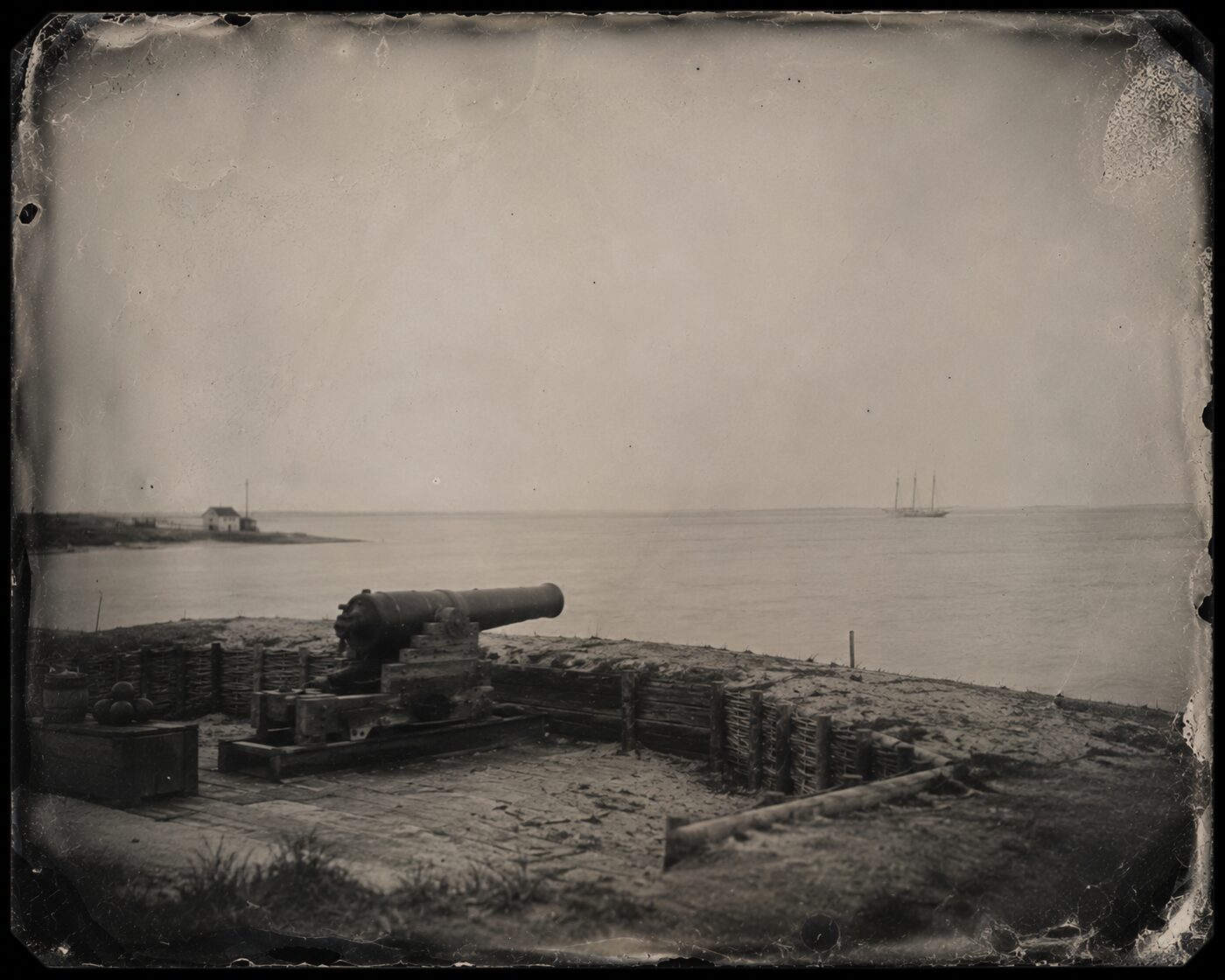
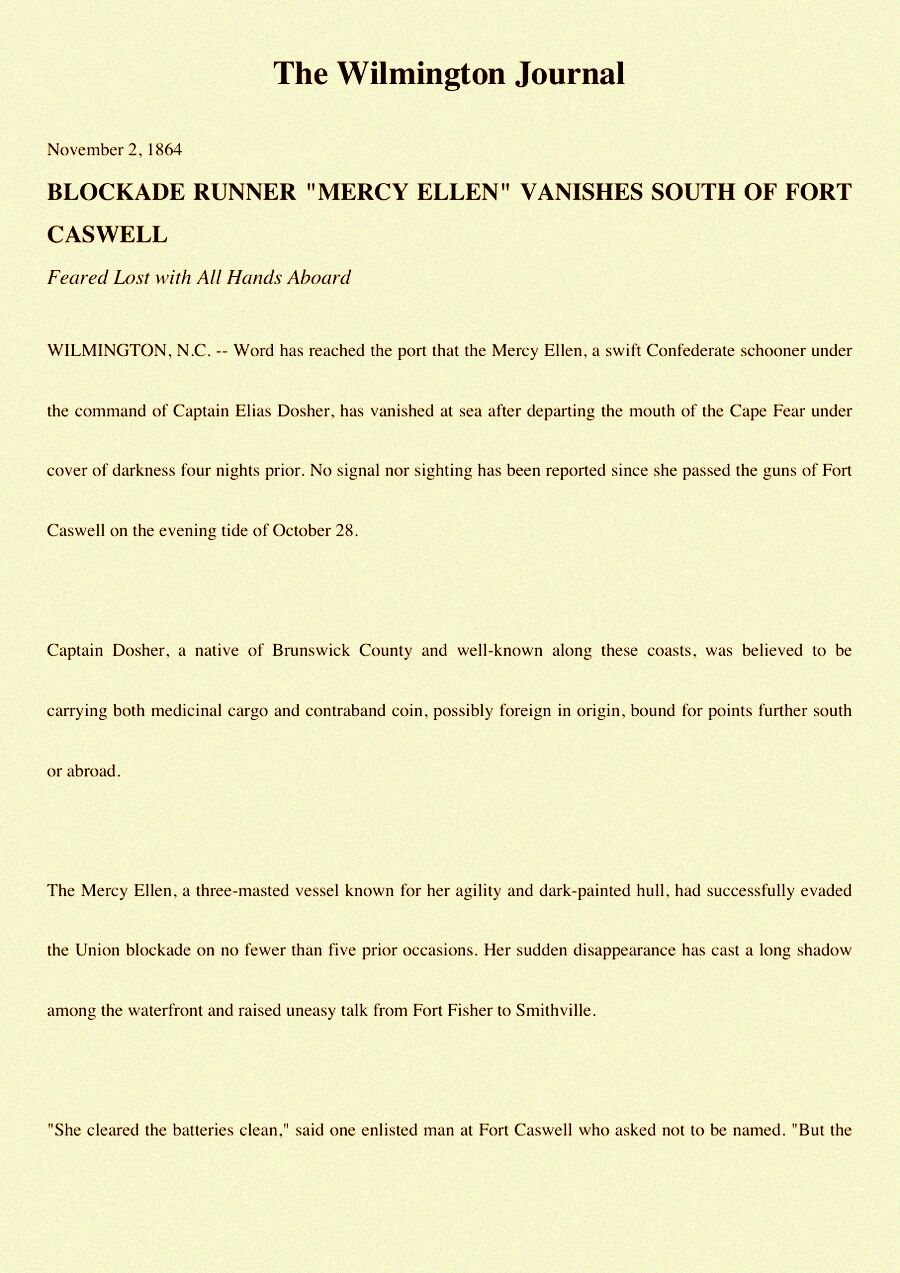
On the evening tide of October 28, 1864, a swift three-masted schooner with a dark-painted hull slipped out of the mouth of the Cape Fear River under cover of darkness. She was the Mercy Ellen, a Confederate blockade runner that had beaten the Union fleet five times before, and she was commanded by one of the best-known mariners on this coast: Captain Elias Dosher of Brunswick County.
She passed the guns of Fort Caswell, cleared the batteries clean, and was never seen again. No signal. No wreckage. No flotsam. Not a glimmer.
"She cleared the batteries clean. But the wind died sudden, and the mist rose like a curtain. No one saw her lights after that, not a glimmer." An enlisted man at Fort Caswell, quoted in The Wilmington Journal, November 2, 1864
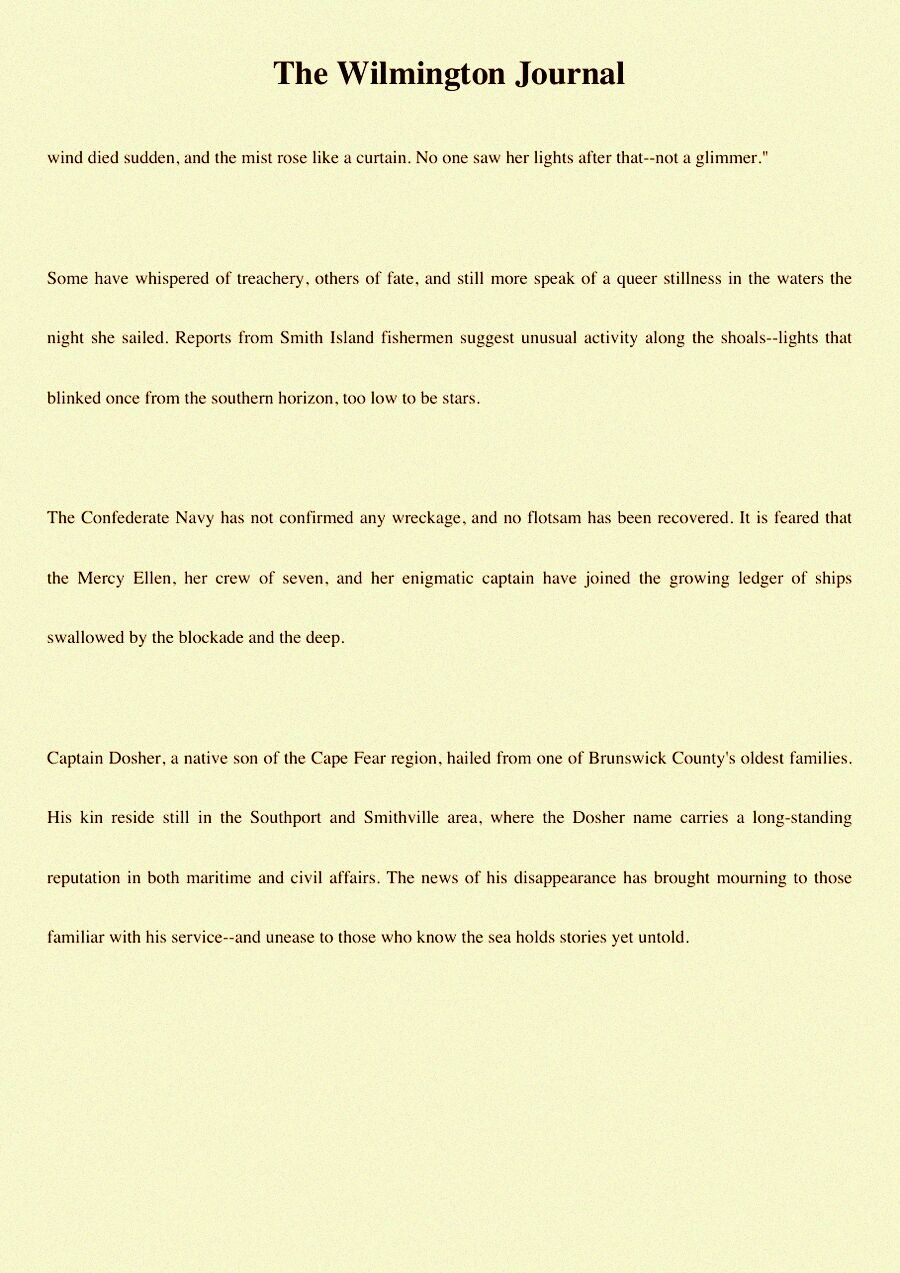
Dosher was carrying medicinal cargo and, it was whispered, contraband coin, gold, possibly foreign in origin. Some said treachery. Some said fate. Smith Island fishermen reported lights that blinked once from the southern horizon that night, too low to be stars. The Mercy Ellen, her crew of seven, and her enigmatic captain joined the long ledger of ships swallowed by the blockade and the deep.
The Captain
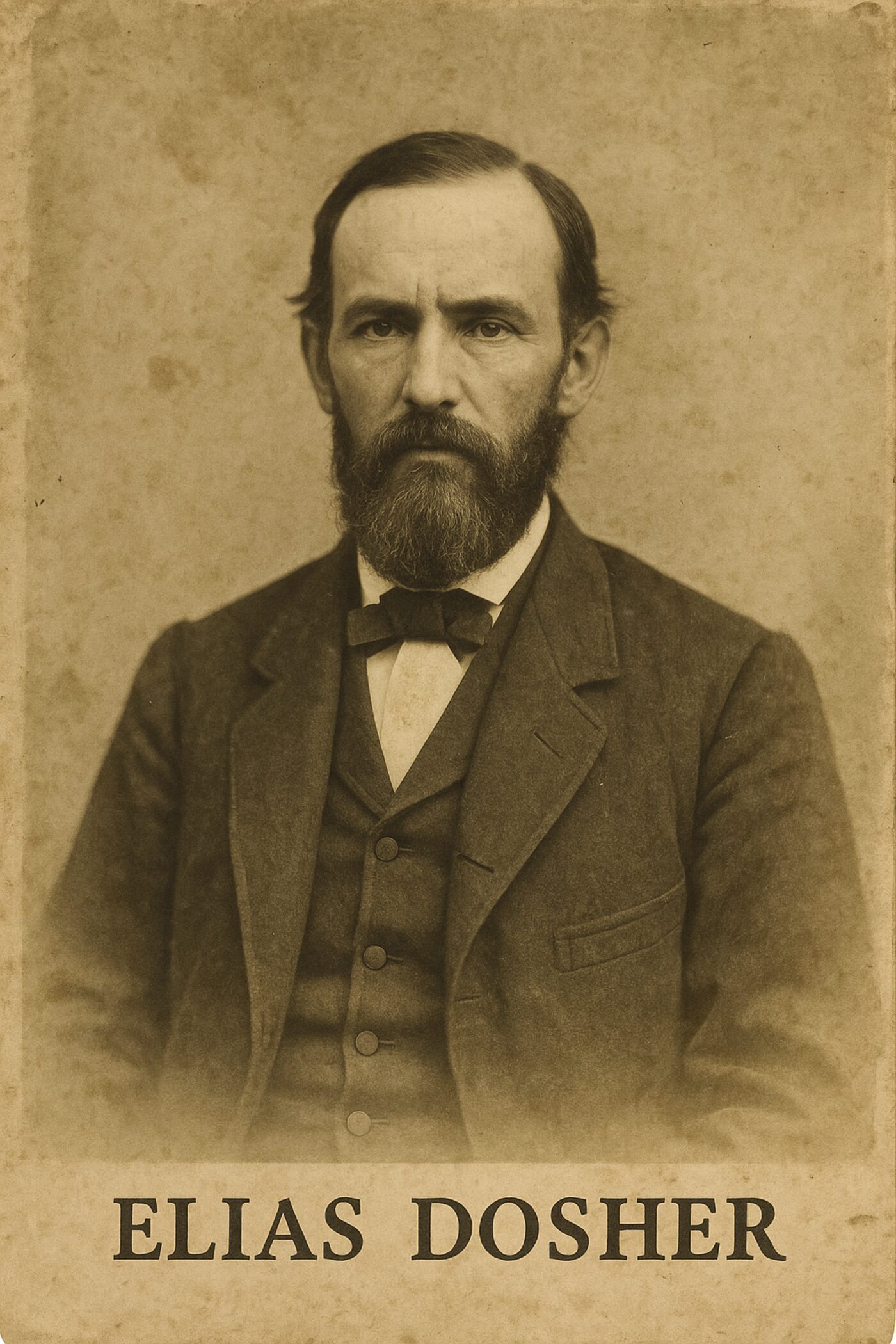
Elias Dosher came from one of Brunswick County's oldest families, the Dosher name still carries weight in Southport today. He was a blockade runner of uncommon skill, and, if the older stories are to be believed, something more complicated: an informant who worked both sides of the blockade. His descendant, local historian Clara Dosher, put it plainly in 1957: "There's talk he made a deal he shouldn't have, trading cargo for gold and double-crossing both sides. The ship vanished the night he disappeared."
A journal attributed to Dosher, donated to the Maritime Museum and first shared publicly during the 1983 Haunted Southport tour, contains this final entry:
"They warned me not to take her to sea. Not with that cargo. But I needed the gold. I saw the lighthouse vanish behind us… then, nothing but the black horizon." From the journal of Elias Dosher
The Caswell Signal
Two flashes. Pause. One more.
✦ ✦ then ✦
It's the old runner's recognition signal, and it is the one thing every sighting has in common. Flash it seaward from the beach between Fort Caswell and the Oak Island Lighthouse after dark, and, so the stories go, a single flash answers from the horizon, too low to be the lighthouse. Then the mist rolls in. Locals warn newcomers not to tempt the legend with lights or calls. Each year, someone does. And each year, the ship answers.
A Century of Sightings
- 1923 Fisherman Henry Beck, unaware of any legend, flicks his lantern three times near the Caswell shore. A ghostly three-masted schooner appears "from nowhere, without a sound", then vanishes after a single answering flash.
, The Southport Chronicle, October 17, 1923
- 1957 Fort Caswell caretaker Earl Simmons flashes his spotlight "just goofing off." A faint beam returns from south of the Oak Island Lighthouse: "It was like it came from another world."
, Wilmington Coastal Observer, June 8, 1957
- 1983 During the Haunted Southport tour, a group tries the signal with an old railway lantern from Fort Caswell's museum. A single flash answers from the waterline beyond Battery Buchanan, leaving "a strange mist and the smell of brine and burnt rope."
, Brunswick Beacon, October 29, 1983
- 2006 Three Southport High students try the signal with a cell phone flashlight during a beach bonfire. One blink answers, then sails, barely lit by the moon, motionless offshore. The Coast Guard logged no vessels in the area.
, The State Port Pilot, October 14, 2006
- 2023 Amateur historians at Caswell Dunes try the signal on a June beach walk. A flash answers, too low to be the lighthouse, and the mist rolls in. Two more sightings follow before October.
, Southport Gazette, October 7, 2023
Sightings cluster in October, near dusk or just after nightfall, always in the same stretch of water between Fort Caswell and the lighthouse. Dr. Abigail Lang, who has studied the phenomenon for over a decade, notes the pattern: "The Mercy Ellen doesn't just appear randomly. It returns when people seek it, and when the season turns. But some say the ship never truly leaves… it only waits."
The Lighthouse That Would Not Flash Twice
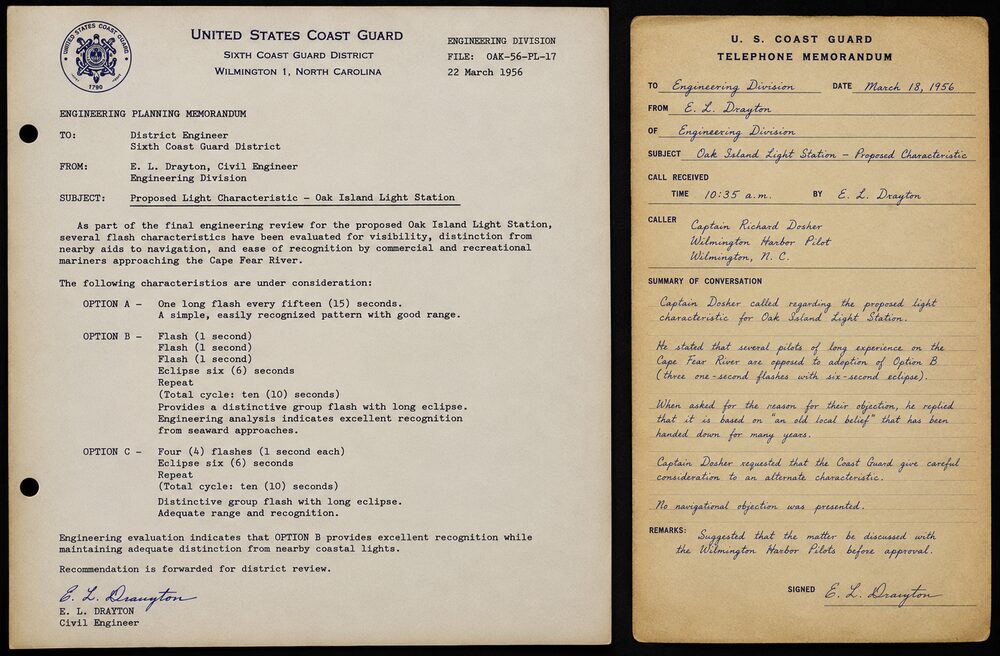
There is a curious official footnote to all this. When the Coast Guard was engineering the new Oak Island Light Station in the 1950s, its planning memoranda weighed several flash characteristics for the tower that would stand over this same stretch of water. The proposed patterns ran into trouble: local mariners and Cape Fear harbor pilots objected, and the correspondence records their reasons only as "concerns" handed down along the waterfront for many years. The pattern finally adopted, four one-second flashes every ten seconds, is the one the light still shows tonight. Whatever the engineers made of it, no one approaching the river sees anything from that tower that could be mistaken, at any distance, for two flashes and then one.
Sources & further reading
- The Wilmington Journal, "Blockade Runner 'Mercy Ellen' Vanishes South of Fort Caswell," November 2, 1864
- The Southport Chronicle, October 17, 1923
- Wilmington Coastal Observer, June 8, 1957
- Brunswick Beacon, October 29, 1983
- The State Port Pilot, October 14, 2006
- Southport Gazette, October 7, 2023
- U.S. Coast Guard Engineering Division memoranda, Sixth District, March 1956