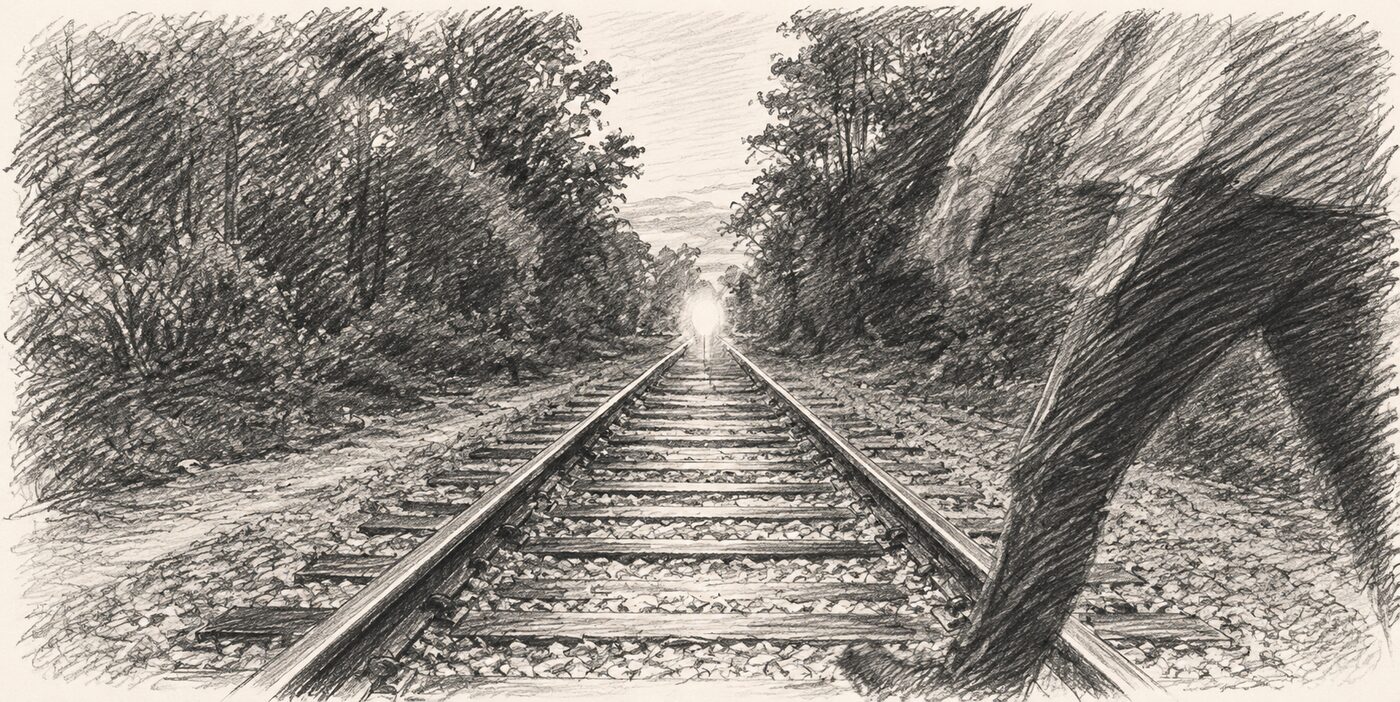
On a summer night in 1867, brakeman Joe Baldwin was riding the last car of a Wilmington, Manchester & Augusta train as it rattled through the pine flats at Maco Station, fourteen miles west of Wilmington. Somewhere in the dark, his car came uncoupled. It slowed. And behind it, the headlamp of a fast-approaching train grew brighter.
Baldwin did the only thing a brakeman could do: he scrambled to the rear platform and swung his lantern in wild arcs, trying to warn the engineer bearing down on him. The oncoming train never slowed. In the collision that followed, Joe Baldwin was decapitated, and his head, so the story goes, was never found. It's said his lantern flew from his hand and burned in the swamp grass, upright, long after the wreck was cleared.
The Light on the Tracks
Not long after Baldwin was buried, the light appeared. Travelers along the rail line at Maco reported a single point of yellow-white light rising over the tracks after dark, swinging side to side at lantern height, moving up the line, then hovering, then vanishing when anyone came near. It came back the next night. And the next. For 110 years.
The Maco Light became one of the most witnessed hauntings in American history. Generations of Brunswick County teenagers parked along the tracks to watch for it. Trainmen took it seriously enough that, according to longtime local telling, engineers on the Maco run took to using two lanterns, one red, one green, so signalmen would not mistake Joe's light for a real brakeman's signal. President Grover Cleveland, whose train stopped at Maco in 1889, is said to have heard the story of the headless brakeman directly from the crew.
"You'd see it come up out of the swamp, low over the rails, swinging like a man walking with a lantern. When you walked toward it, it backed away. When you ran, it went out." As told by generations of Maco witnesses
Skeptics blamed swamp gas, automobile headlights refracting off the wetlands, and atmospheric tricks. Investigators came with instruments; a Smithsonian-affiliated team is often said to have gone away without an answer. The light kept its own counsel: it appeared where it wished, retreated when chased, and was seen by thousands.
The Heyday of the Light
By the middle of the twentieth century, the Maco Light was a destination. On warm nights, cars lined the dirt road beside the right-of-way, headlights off, whole families waiting in the dark. Skeptics arrived with shotguns and left without an explanation. Soldiers from Fort Bragg camped along the line to catch it. Hunting dogs sent after the light circled back whining. The light obliged them all: it rose, swung, retreated, and vanished on its own schedule, exactly as it had for the trainmen of the 1870s.
Explanations came and went with the decades. Swamp gas. Foxfire. St. Elmo's fire. Automobile headlights bending off the wetlands, a theory that had to contend with the inconvenient fact that the light had been reported decades before the automobile. Each investigation ended the same way: with instruments packed up, a report politely inconclusive, and the light back on the tracks the next night.
The Rails Come Up, the Light Goes Out
In 1977, the Seaboard Coast Line pulled up the tracks through Maco. The crossings were paved over, the right-of-way grew in, and the light was never seen again. Whatever walked the Maco line walked it only as long as there were rails to walk. If Joe Baldwin finally found what he was looking for, he found it just in time.
Curiously, the historical record has its own version of events: railroad archives show a conductor named Charles Baldwin killed in an eerily similar accident near the same spot, in January 1856, eleven years before the legend's date. The name changed, the date drifted, but the man, the wreck, and the lantern are all there in the record. The light, of course, needed no documentation at all.