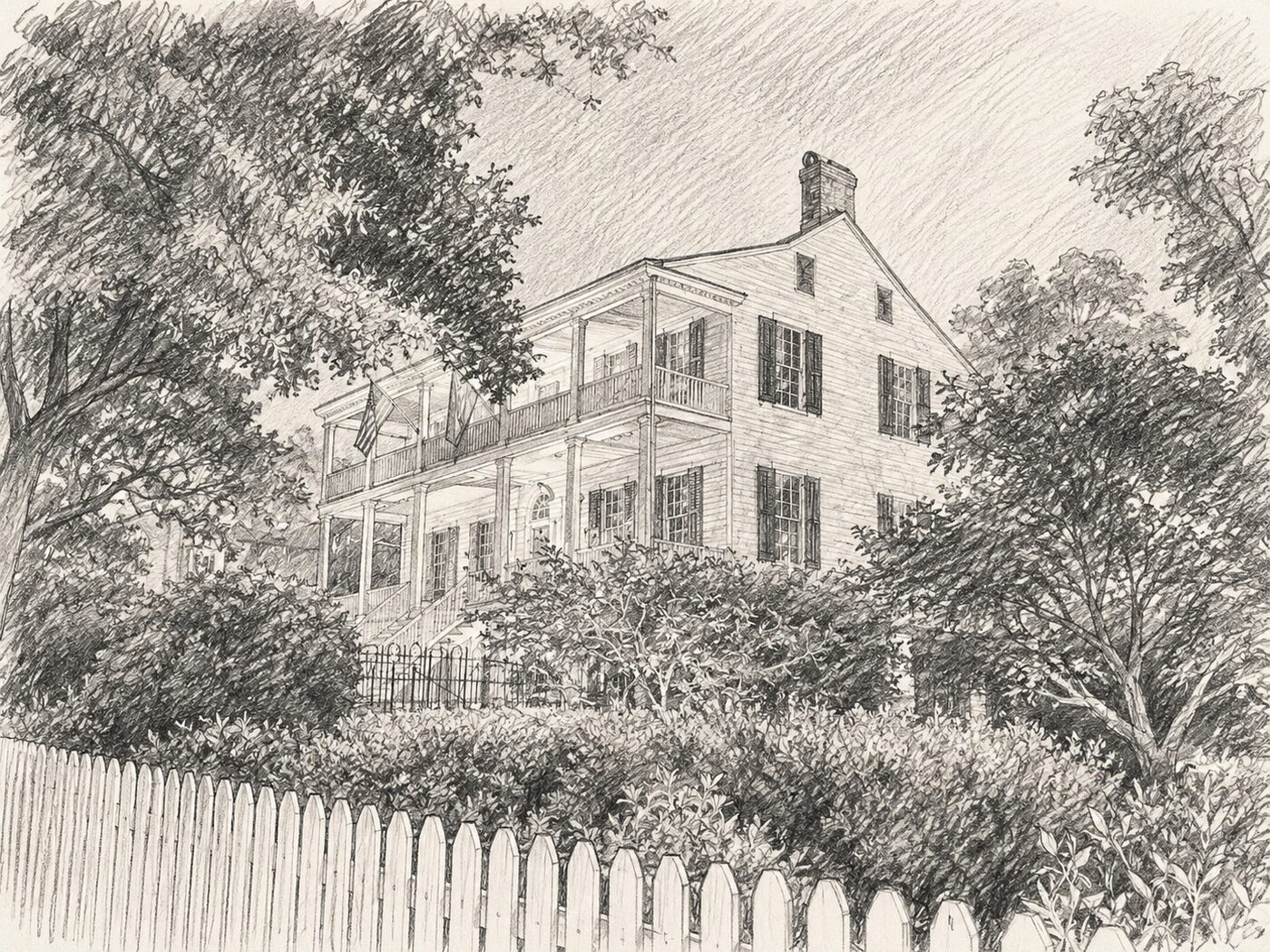
The Burgwin-Wright House
Wilmington's grandest colonial home was built in 1770 on the massive stone foundations of the city's first jail: its cellars were once cells, and a dungeon survives beneath the garden. Lord Cornwallis headquartered here in 1781. Staff and visitors report footsteps on empty stairs, doors that unlatch themselves, and the sensation of being watched from the old jail level. The museum leans in: its own podcast investigates the ghost stories through the house's dual history of grandeur upstairs and misery below.
The Bellamy Mansion
The white-columned antebellum showpiece at Fifth and Market was finished in 1861, just in time for war, occupation by Federal troops, and a century and a half of whispered stories. Long-time locals watched lifelong residents pass just out of view behind the iron gates and wondered whether the house held more residents than the living. Staff still report the scent of cigar smoke in Dr. Bellamy's study and figures at the upstairs windows when the house is closed.
The Latimer House
Home to the Latimer family for over a century, this 1852 Italianate mansion knew tremendous loss: the family buried child after child within its walls in an era when childhood itself was a gamble. Visitors report small faces lingering in the windows and the sound of children racing across the upstairs floors long after the rooms below have gone quiet. The Lower Cape Fear Historical Society, headquartered there, treats the stories as part of the house's honest record of 19th-century life and death.
Thalian Hall
Opened in 1858 and still staging shows, Thalian Hall is the grande dame of American theaters, and, by long theatrical tradition, occupied. Performers describe unexplained presences in the wings, cold spots on the catwalks, and "ghostly helping hands" that steady a ladder or close a door at exactly the right moment. Three spirits are said to watch performances from the gallery, patrons of the house since the gaslight era.
The Wilmington Railroad Museum
Built on the former yards of the Atlantic Coast Line, the museum honors the men who kept the trains running, and who died doing it. Staff report tools moved between closing and opening, footsteps in the freight warehouse, and a uniformed figure seen among the rolling stock. Fittingly, the museum also keeps the archive on Joe Baldwin, the headless brakeman of the Maco Light.
Brunswick Town & Fort Anderson
The Cape Fear's first permanent settlement, founded 1726, burned by the British in 1776 and never rebuilt, then entombed a second time when Confederate engineers raised Fort Anderson's earthworks over the ruins. The colonial ballast-stone walls of St. Philip's Church still stand roofless among the mounds. Visitors and staff report colonial figures among the ruins, drums and voices from the empty earthworks, and lights moving along the river where the town docks once stood.
The Battleship North Carolina
The most decorated American battleship of World War II lies moored in the Cape Fear across from downtown. Ten men died aboard her in wartime. Crew and visitors have reported a young sailor moving through the passageways, hatches that open and slam in still air, and voices in the washrooms belowdecks, enough that the ship's own programs staff addresses the question head-on. Paranormal investigators consider her one of the most active vessels afloat.
The Grave of Samuel Jocelyn
In 1810, young Samuel Jocelyn quarreled at a hunting lodge north of town, rode off alone into the night, and was found the next day lying in shallow water near the sound. He was buried quickly in the churchyard of St. James. Two nights later he appeared at the bedside of his closest friend, Alexander Hostler, and asked a question no friend should ever have to hear: "How could you let me be buried when I am not yet dead?"
The vision returned three nights running, to Hostler and to a second friend, until the two men took lanterns and spades to the churchyard and opened the grave. What they found there has kept this story alive for two centuries: the coffin lining shredded, the lid scored from the inside, and Jocelyn's fingers torn raw. He had been buried in a coma and woken underground. Visitors to the churchyard still report muffled cries and a frantic scratching from the old section after dark, and a restless figure that walks the rows as if looking for the way out.
Fort Fisher
The great earthen fort that kept Wilmington open to the blockade runners fell in January 1865 in the largest amphibious assault of the war, and its defenders have not entirely stood down. The best known of them is Major General W.H.C. Whiting, who was wounded leading the defense, taken prisoner, and died in a New York harbor prison far from the river he had fortified. Legend says death did not keep him from returning to his post: a gray-clad figure is seen at dusk on the old parapet, gazing up the road toward the north, where the attack came from.
He does not walk alone. Staff and visitors report a Confederate sentry standing watch in the pine grove north of the fort, footsteps on the wooden walkways, a figure that comes up from the ocean toward the works, and, on certain still nights, the sound of gunfire rolling in over the water from a battle a century and a half finished.
Poplar Grove Plantation
A peanut plantation from the late 1700s, home and haven to the Foy family for generations and an important site for telling Gullah Geechee history. Two centuries of life, and bondage, and loss, have left their mark: staff report a woman in period dress crossing the manor house hallways, rocking chairs that move on the porch, and cookfire smells from the long-cold kitchen dependency.
Sources & further reading
- Burgwin-Wright House: "Haunted Tales of the Cape Fear" podcast series (episodes on all eight sites, with each site's own historians)
- Wilmington Railroad Museum
- Battleship North Carolina
- WWAY TV3: Buried Alive, Man's Ghost Still Roams Wilmington Cemetery
- CoastalGuide: The Ghost of Fort Fisher