Of all the hauntings on the Cape Fear, this is the one with the finest pedigree: it was set down in 1898 by James Sprunt, shipping magnate, historian of the river, and a man who had captained blockade runners himself, in his Christmas-themed account "A Colonial Apparition." Sprunt did not deal in idle tales. This one he took from the river men who lived it.
Sprunt knew this river as well as any man alive. He had gone to sea as a teenage purser aboard the blockade runners of the 1860s, survived capture and the collapse of the Confederacy, and returned to build one of the largest cotton export houses in the world from the Wilmington waterfront. When he later wrote his great histories of the region, he salted them with the stories the river men told, and he preserved this one for good.
The story begins a century earlier, during the Revolution. The lower Cape Fear was thick with Highland Scots then, families who had come to the colony in waves after Culloden, and the Revolution split them bitterly. Two Scotsmen were executed by the British on the river between Wilmington and Southport. Their deaths were remembered along that stretch of water for generations; by the nineteenth century, river folk told of two apparitions that appeared near the old plantation landing during storms, the Scotsmen, some said, still looking for a ship to carry them home.
Captain Harper's Run
One winter evening, Captain John M. Harper, among the best-known steamboat men on the river, was making the run from Wilmington down to Southport as the weather turned cold and ugly. In the darkness, his crew fell to retelling the old sightings. The wind rose. The rain came on. And as they passed the haunted stretch, one of the crew saw a figure clutching the rail, a man with his beard crusted in ice. The crewman lunged to save the stranger from going overboard, and his hands closed on nothing. The figure was gone.
Captain Harper, told of it, did what good captains do: he made a joke of it, told the men to keep a weather eye out for more ghosts, and held his course. Then the shrieking began.
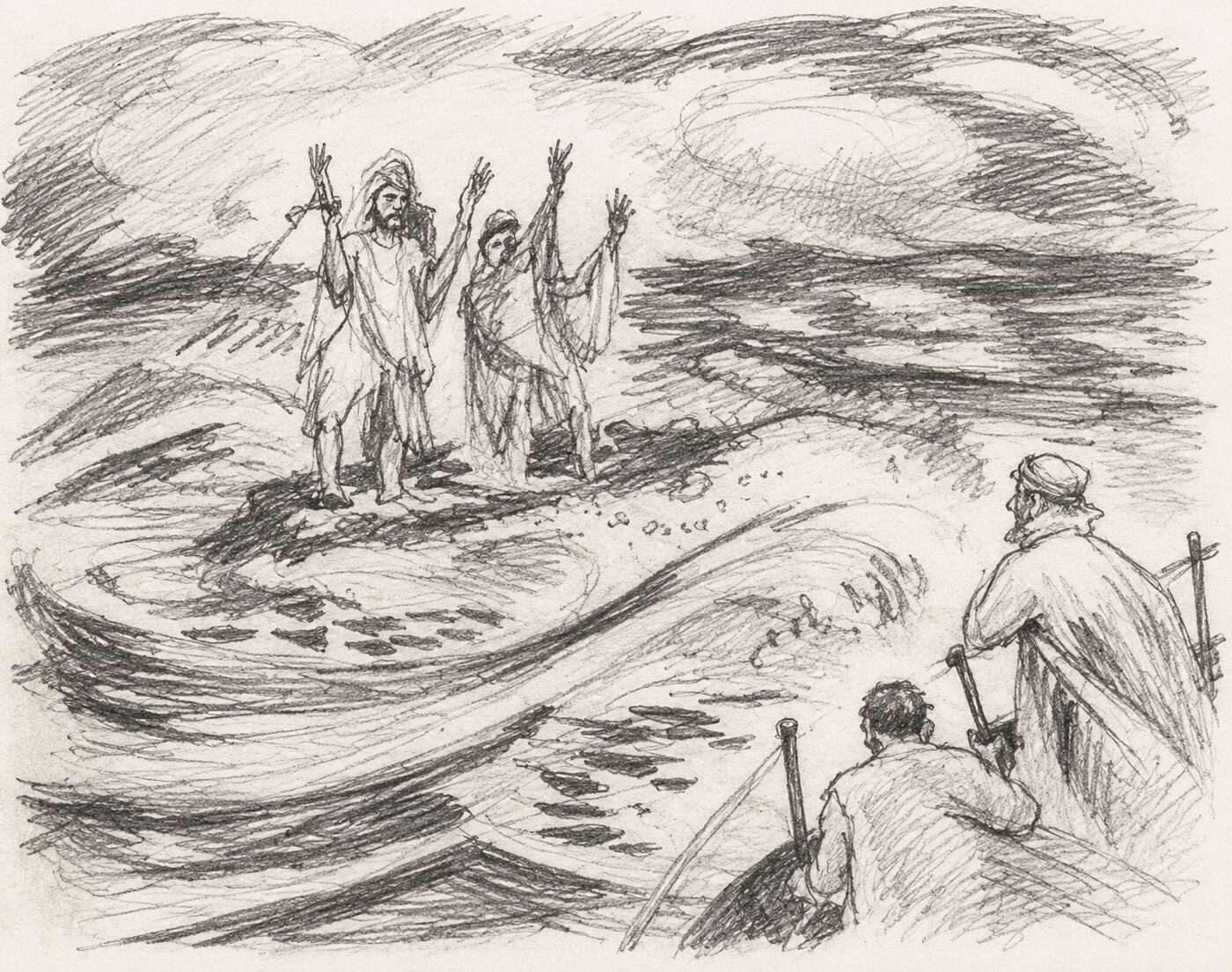
It came across the water from the direction of shore, from the spot where colonial ships used to lie at anchor, and it grew louder and louder until something took shape in the darkness ahead: a barge, impossibly ancient, hung with seaweed, wallowing in the storm swell. Harper ordered his crew to render aid. As they threw a line, they saw what the barge carried: two figures in Scottish garb, wrapped in chains, their arms outstretched toward Harper's boat. The moment the line touched, the rotting hulk was swallowed by the waves.
"No sooner had they begun to throw a line, than they saw two figures dressed in Scottish garb wrapped in chains on board… the ghostly figures reached toward Captain Harper's ship." From the legend as retold from James Sprunt's "A Colonial Apparition," 1898
The Rescue
There is a coda, and it is the detail that has kept this story alive for over a century. Continuing downriver through the storm, Harper's crew came upon a real wreck, a boat broken by the weather, with two exhausted, half-frozen men aboard, shouting themselves hoarse for help. They were saved. The rational among the crew concluded the earlier screaming had been these men all along.
Most of the crew did not agree. The screaming they heard first, they insisted to the end of their days, had come from the other vessel, the one that sank without ever having floated, crewed by two men a hundred years dead, still waiting on the Cape Fear for a ship to carry them home.
Sources & further reading
- James Sprunt, "A Colonial Apparition," 1898
- Carolinas Unknown: Cape Fear River Colonial Apparition & Phantom Barge
- James Sprunt, Chronicles of the Cape Fear River, 1914